
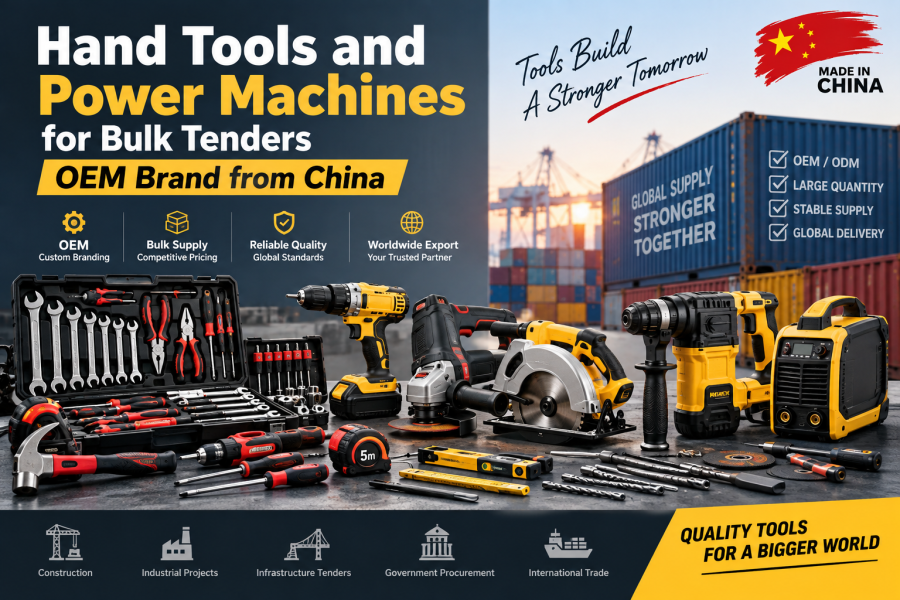
Tenders for hand tools and power machines look like the easiest kind to bid. The items are familiar, the specifications are short, and the quantities are large. In practice they carry more risk than a single machine tender, because the value sits in thousands of small units and a single misunderstanding is multiplied across the whole order.
Who buys tools in bulk
The recurring buyers are vocational training institutes kitting out workshops, public works and municipal departments equipping maintenance crews, railway and utility operators, defence and police logistics, and donor programmes distributing livelihood kits. Each has a different priority. A training institute wants durability under inexpert use. A utility wants standardisation across depots. A livelihood programme wants a complete, sealed kit that can be handed over intact.
Read the tender to work out which one you are dealing with, because it changes what to offer. The cheapest compliant tool wins a price driven lot and loses a durability driven one.
Quantity bands change the unit price more than you expect
Tool manufacture is tooling driven. The cost of a forged spanner or an injection moulded case falls sharply once the run justifies dedicated tooling, and it falls again at container volumes. This means the unit price you were quoted for a sample order is not the price at ten thousand units, and a bid built on the wrong band is either uncompetitive or unprofitable.
When you send us a tender, send the full quantity schedule rather than one line. We price against the total run, and if a small increase in quantity crosses a band we will say so, because occasionally bidding slightly more units costs less in total.
Samples, and the time they take
Most institutional tool tenders require sample submission, either with the bid or before the first bulk shipment. Some require the sample to be tested. This is the single most common cause of a missed schedule, because bidders discover the sample clause after they have already committed to a delivery date.
- Check whether samples are required at bid stage or at contract stage.
- Check whether they must be from production tooling or whether a prototype is acceptable.
- Check whether an accredited test report is required, and for which items.
- Add the sample cycle to the schedule before you write the delivery date into the bid.
We can produce samples ahead of the bulk run, but the honest position is that samples add weeks, and a schedule that ignores them is a schedule that will slip.
Power machines carry an electrical file that hand tools do not
Once a lot includes drills, grinders, saws or bench machines, the compliance requirement changes. Voltage and frequency must match the destination, the plug pattern must match, and many tenders require a safety certification for powered equipment. Insulation class, no load speed and declared power should appear on the datasheet rather than being described loosely. We fix the electrical specification at the order stage, so the tools arrive ready to plug in rather than needing adaptors bought locally.
Marking, branding and packaging for onward distribution
Institutional buyers frequently require the equipment to carry a mark: a department name, an asset code, a programme logo, sometimes a serial range. It is far cheaper to apply that in production than to sticker thousands of units on arrival, and it should be raised at quotation stage.
Packaging deserves equal attention. Tools destined for a central store can travel in bulk cartons. Tools destined to be handed out as kits should leave the works already assembled into kits, boxed and labelled, so nobody has to repack them in a warehouse. Tell us which, and we will quote the packing configuration and the resulting container volume so you know what you are booking before you book it.
Warranty on items that wear out
A warranty clause written for machinery applies awkwardly to hand tools, where blades, bits, abrasives and batteries are consumables rather than failures. Where the tender allows, separate the consumables from the warranted items in your offer and say so plainly. It avoids a dispute later, and evaluators generally read it as competence rather than as a caveat.
Counting, and the discrepancy nobody budgets for
On an order of several thousand pieces, the count itself becomes a commercial term. Tenders usually specify a tolerance and a remedy, and a bidder who has not read that clause can find the final payment held against a shortfall of a fraction of one per cent. Agree how the count will be verified, at which point in the chain, and by whom. We pack to a stated piece count per carton and put that count on the packing list, so a dispute can be settled against paperwork rather than by opening every box in a warehouse.
What we provide behind your bid
Manufacturer authorisation letters naming the tender, technical datasheets per item in the schedule format, sample submissions where required, pre shipment inspection at the works if the tender demands it, and the full export document set from our Chinese ports. Send us the quantity schedule, the destination and the deadline, and you will have a priced, documented response with a delivery date we can hold to.